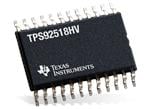

TPS92518HVPWPR

Texas Instruments
595-TPS92518HVPWPR
TPS92518HVPWPR

Produttore:

Descrizione:
CI driver per illuminazione a LED 65-V dual buck LED c ontroller with SPI A 595-TPS92518HVPWPT

Modello ECAD:
Scarica il Library Loader, uno strumento gratuito che consente di convertire questo file per il tuo strumento ECAD. Maggiori informazioni sul modello ECAD.

A magazzino: 1.169

A magazzino:
1.169 Spedizione immediata
Tempo di consegna da parte della fabbrica:
18 settimane Tempo di produzione stimato in fabbrica per quantità superiori a quelle indicate.
Minimo: 1   Multipli: 1
Prezzo Unitario:
-,-- €
Prezzo esteso:
-,-- €
Stima Tariffa:
Confezione:
Nastrati completa (ordinare in multipli di 2000)

Prezzi (EUR)

Qtà Prezzo Unitario
Prezzo esteso
Nastro tagliato / MouseReel™
2,92 € 2,92 €
2,19 € 21,90 €
2,00 € 50,00 €
1,81 € 181,00 €
1,71 € 427,50 €
1,63 € 815,00 €
1,54 € 1.540,00 €
Nastrati completa (ordinare in multipli di 2000)
1,48 € 2.960,00 €
1,44 € 5.760,00 €
† La commissione 5,00 € MouseReel™ verrà aggiunta e calcolata nel carrello. Nessuno degli ordini di articoli MouseReel™ può essere annullato o reso.

Confezione alternativa

Produttore Codice prodotto:
Imballaggio:
Reel, Cut Tape, MouseReel
Disponibilità:
A magazzino
Prezzo:
3,26 €
Min:
1

Prodotto analogo

Texas Instruments TPS92518HVPWPT
Texas Instruments
CI driver per illuminazione a LED 65-V dual buck LED c ontroller with SPI A 595-TPS92518HVPWPR

Attributo del prodotto Valore dell'attributo Seleziona attributo
Texas Instruments
Categoria prodotto: CI driver per illuminazione a LED
RoHS::  
2 Output
Buck
5 A
HTSSOP-24
65 V
6.5 V
2 MHz
Adjustable
TPS92518HV
- 40 C
+ 125 C
Brightness Control/Dimming, High Output Accuracy, Thermal Shutdown
Reel
Cut Tape
MouseReel
Marchio: Texas Instruments
Kit di sviluppo: TPS92518EVM-878
Oscuramento graduale: Analog, PWM
Tensione di ingresso: 6.5 V to 65 V
Sensibili all’umidità: Yes
Stile di montaggio: SMD/SMT
Numero di canali: 2 Channel
Prodotto: LED Controllers
Tipo di prodotto: LED Lighting Drivers
Quantità colli di fabbrica: 2000
Sottocategoria: Driver ICs
Corrente di alimentazione - Max: 4 mA
Tipo: Controller Inductive
Peso unità: 154,500 mg
Prodotti trovati:
Per visualizzare prodotti simili, spunta almeno una casella di controllo
Seleziona almeno una casella di spunta qui sopra per visualizzare prodotti simili in questa categoria.
Attributi selezionati: 0

Questa funzionalità richiede l'attivazione di JavaScript.

TARIC:
8542399000
CNHTS:
8542399000
CAHTS:
8542310000
USHTS:
8542310030
MXHTS:
8542399901
ECCN:
EAR99

IS32LT3175N/P Single-Channel Linear LED Drivers

ISSI IS32LT3175N/P Single-Channel Linear LED Drivers come with fade in/out and PWM dimming. The regulators serve as a stand-alone LED driver-configurable from 20mA to 150mA with external resistors, no microcontroller is necessary. A logic level “courtesy light” signal from the PWM pin can be interfaced to precisely drive the LED channel. The IS32LT3175P obtains a positive polarity PWM signal. In addition, the IS32LT3175N obtains a negative polarity PWM signal. The regulator integrates a 63-step fade-in and fades out the algorithm (Gamma correction). This causes the output LED current to increasingly rise up to the full source value after the EN pin is pulsed.

TPS92518HV Dual Buck LED Controllers

Texas Instruments TPS92518HV Dual Buck LED Controllers with SPI Interface, Analog and PWM Dimming are ideal for multichannel and platform lighting driver module (LDM) applications. The TPS92518HV LED Controllers apply a high-voltage option with an input range of up to 65V. A quasi-hysteretic control method in the Texas Instruments TPS92518HV supports switching frequencies ranging from 1kHz to 2MHz, enabling superior, high-frequency shunt FET dimming. Additionally, the control method handles demanding dynamic loads of adaptive LED matrix-based headlamp systems. Software programmable SPI set points such as Precision Peak Current, Controlled Off-Time, and Output Voltage Sense Software allow designers to develop a single LED driver solution for multiple load configurations. These SPI set points can be rapidly reconfigured for future LED driver design requirements.